Scale factor map worksheet word problems help students practice converting between map distances and real-world distances using a given ratio. These problems show up in middle school math, geography classes, and standardized tests and they’re not just about calculations. They teach how to read maps accurately, estimate travel distances, and understand why a 1:50,000 scale means 1 cm on the map equals 50,000 cm (or 500 m) on the ground.
What does “scale factor” mean on a map?
A scale factor is the ratio that compares a measurement on a map to the actual distance it represents. It’s usually written as 1:x, where x is how many real-world units match one unit on the map. For example, a scale of 1:25,000 means every 1 mm on the map equals 25,000 mm (25 m) in reality. Word problems ask students to use that ratio to find missing distances like “If two towns are 4.2 cm apart on a 1:100,000 map, how far apart are they in kilometers?”
When do students actually use these worksheets?
Teachers assign scale factor map worksheet word problems when introducing proportional reasoning or preparing for fieldwork like orienteering or local history projects. Students also use them in real-world contexts measuring hiking trail lengths from topographic maps, planning bike routes using city maps, or comparing distances between landmarks. You’ll find similar thinking in our worksheet using landmarks, where students calculate distances between well-known sites like the Statue of Liberty and Ellis Island using official park maps.
How do you solve a typical word problem step by step?
Start by identifying the scale (e.g., 1 cm = 2 km), then note what’s given (map distance or real distance) and what’s asked. Convert units if needed many mistakes happen when students forget to change centimeters to kilometers or inches to miles. Multiply or divide using the scale factor consistently. For instance: “A map shows a river segment 7.5 cm long at 1:50,000.” First, 1 cm = 50,000 cm = 500 m, so 7.5 × 500 = 3,750 m = 3.75 km.
What mistakes do students make most often?
- Ignoring unit conversions using cm on the map but forgetting to convert final answer to km or miles
- Mixing up the direction of the scale (e.g., treating 1:25,000 as “1 real unit = 25,000 map units” instead of the reverse)
- Skipping estimation checks like realizing 12 cm on a 1:100,000 map can’t be 12 meters in real life (it’s actually 12 km)
- Using addition or subtraction instead of multiplication/division when scaling up or down
Where can I find practice problems with clear visuals and answers?
Our calculating map scale worksheet includes grid-based maps, mixed units (inches, miles, km), and answer keys with full unit conversion steps. It’s designed for students who get tripped up moving between inches and miles or centimeters and kilometers without losing track of the scale factor. Another option is our historical battle maps worksheet, which uses real Civil War-era maps to connect scale math with context like measuring troop movement distances from Gettysburg maps.
Can I adapt these problems for different grade levels?
Yes. For younger students, stick to whole-number scales like 1 cm = 5 km and distances under 20 cm. For older learners, introduce fractional scales (1/4 inch = 1 mile), metric-imperial mixes, or multi-step problems like finding total driving distance across three map segments with different scales. A helpful font for clean, readable worksheets is font name, which keeps numbers and labels distinct and easy to scan.
Next step: Pick one worksheet based on your current need use the landmark-based version if you want immediate relevance, the unit conversion version if unit errors keep happening, or the battle maps version if context helps your students stay engaged. Work through the first three problems together, then have students explain each step aloud not just the answer.
 Calculating Scale Factors with Famous Landmarks
 Planning Your Model Train Layout with Scale Factor Worksheets
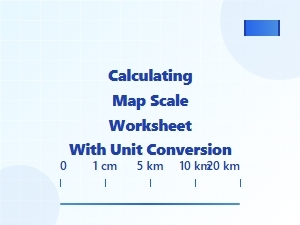 Mastering Map Scale and Unit Conversion Exercises
 Analyzing Battle Maps with a Scale Factor Worksheet
 Understanding Scale Factor Problems in Design
 Beginner Scale Factor Drawing Practice on a Grid